Essay · 2026-09-26
I benchmarked all 17 GPT-6 settings; this is how I use them now
GPT-6 results suggest increasing reasoning effort pays off—but cost and latency rise sharply, and the best model family depends on your budget.
This is a follow-up to my earlier GPT-5.6 comparison. GPT-6 has three model families: Luna, Sol, and Astra. Each family supports multiple reasoning-effort settings: non-reasoning, low, medium, high, xhigh, and max. That raises the practical question: should you increase effort, or move up to a more capable family?
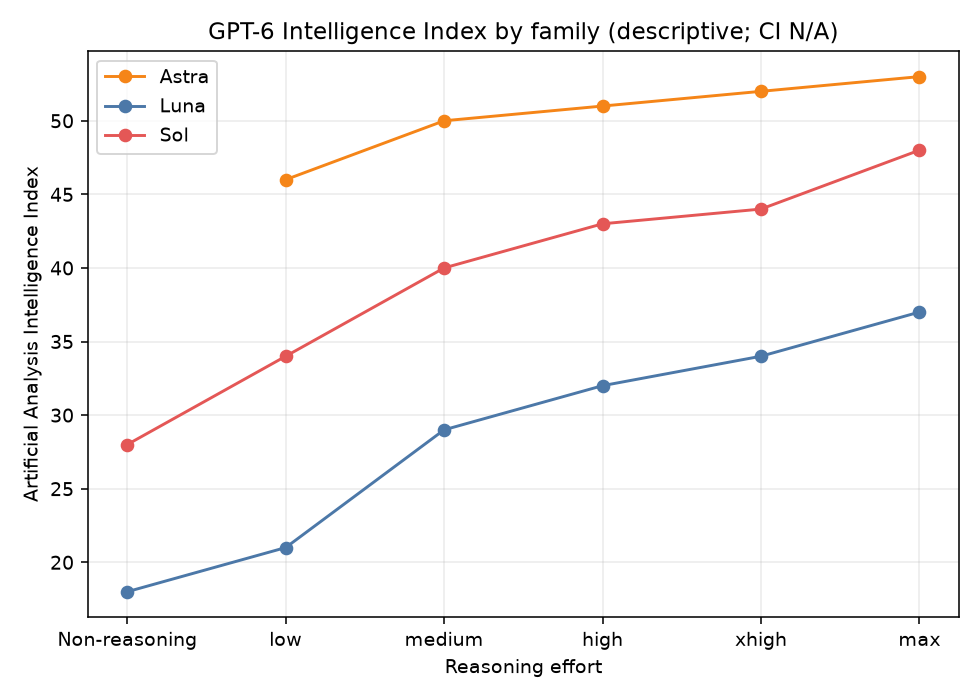
I compared results from the Artificial Analysis Intelligence Index, cost per task, and time per task. The published intelligence index rises with effort across all three families.
Intelligence vs cost
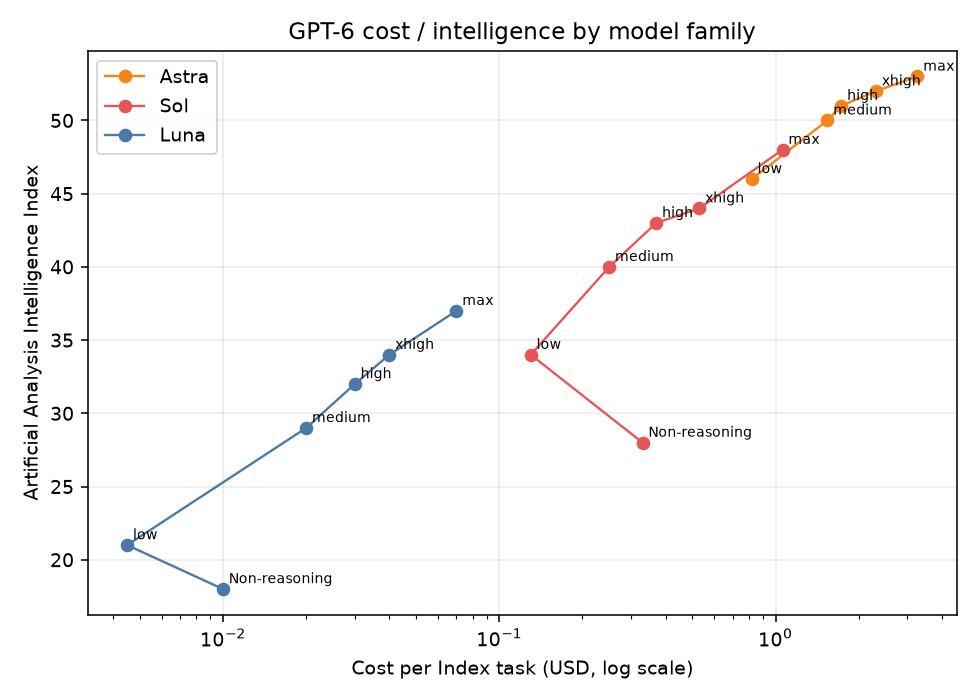
Of course, intelligence is not the only metric we worry about. Cost is a major consideration. Higher effort generally buys more Intelligence Index points, but costs more and takes longer. The biggest practical contrast is between Luna and Astra: Luna at max costs about $0.07 per task and takes 5.7 minutes, scoring 37. Astra at max costs about $3.26 and takes 7.8 minutes, scoring 53 (higher score better). Also note that we never want to use non-reasoning, which is always more expensive and less intelligent than low for Luna and Sol.
The analysis becomes clearer with a Pareto frontier, which is the same analysis we used for GPT-5.6. A model is on the intelligence-vs-cost Pareto frontier when no other model is both cheaper and more intelligent. In other words, each frontier option represents a point where you cannot improve one dimension without giving up something in the other.
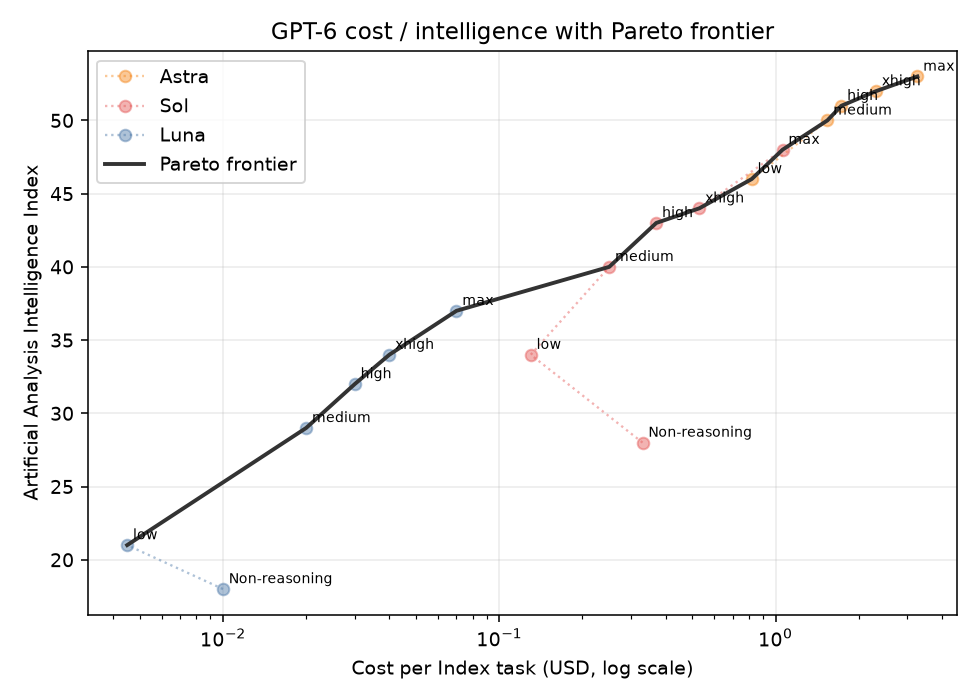
Compared with GPT-5.6, the tradeoff is clearer. So the new Pareto frontier starts with GPT-6 Luna low and increasing to max before migrating to GPT-6 Sol med and increasing to max. This was the same pareto-optimal tradeoff we found with GPT-5.6. Put differently, GPT-5.6 Terra wasn't competitive on the Pareto frontier, which may be why OpenAI didn't release Terra with GPT-6.
Finally, after GPT-6 Sol max, we would switch to GPT-6 Astra medium, increasing to max. This represents a higher (and more costly) intelligence tier and is where you go for ultimate performance.
Intelligence vs time
While cost is probably the most important metric, time matters too. Below we see the tradeoff between intelligence and time. The underlying data lacked timing results for medium reasoning-effort times, so they are missing in the plot below. As with the intelligence-vs-cost Pareto frontier, we never want to use non-reasoning, which is always slower and less intelligent than low for Luna and Sol.
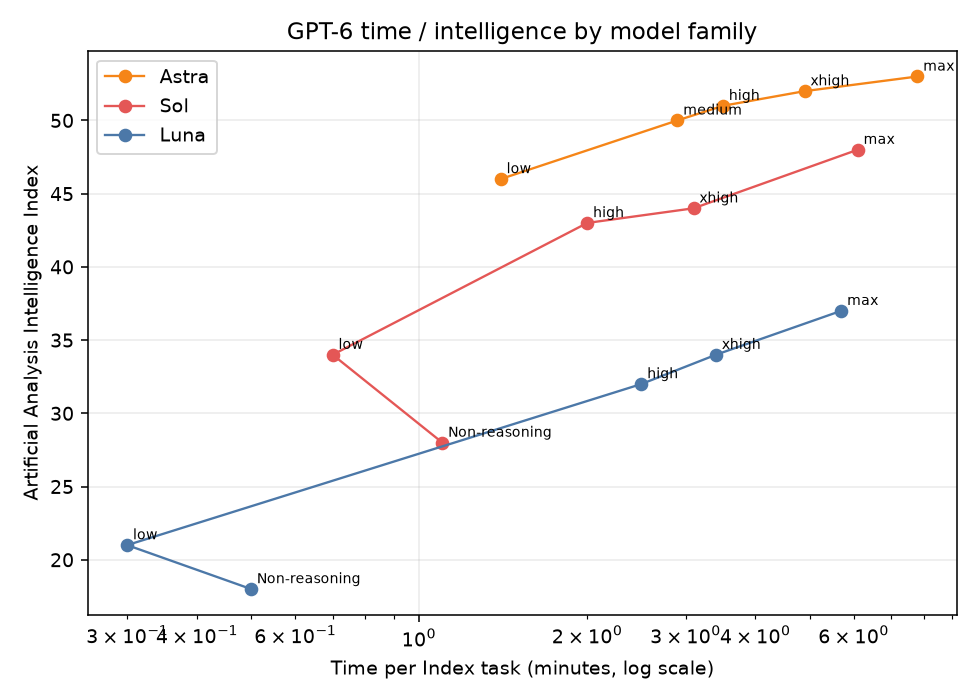
We get dramatically different results when we look at time instead of cost. We can see that Sol low and Luna xhigh have similar intelligence performance but Luna is about 3 times cheaper but Sol is 5 times faster. The intelligence-vs-time Pareto frontier better illustrates the tradeoff.
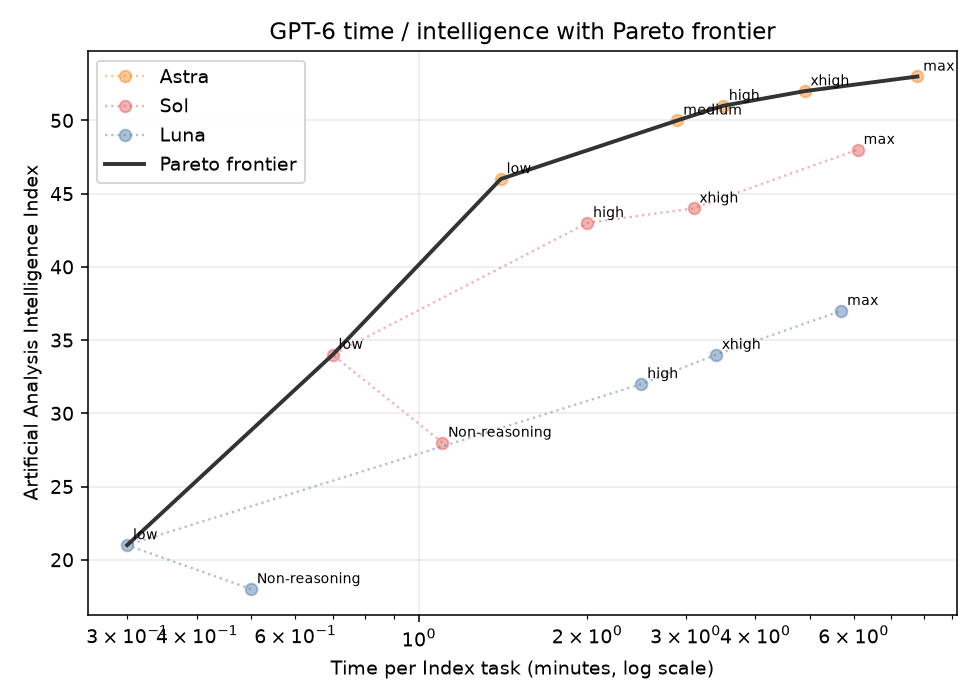
Following the Pareto frontier, we start at Luna low and move directly to Sol low before moving to Astra low and moving up reasoning levels to Astra max. Whereas we stuck to the lower families (exhausting at max) when we were concerned about cost, we tend to jump immediately to the higher families when time is the concern. Whereas before, the low reasoning efforts never made the Pareto frontier, they suddenly make sense when we care about time.
Does effort beat moving up a family?
Across selected paired benchmark comparisons, score gains in intelligence are positive in every case:
| Comparison | Benchmarks | Mean gain | Median gain | Bootstrap 95% CI |
|---|---|---|---|---|
| Luna medium → Luna max | 13 | +24.92 | +8.00 | [+5.92, +60.92] |
| Sol medium → Sol max | 14 | +31.07 | +5.00 | [+4.14, +80.57] |
| Astra medium → Astra max | 14 | +10.50 | +2.50 | [+1.64, +26.50] |
| Luna max → Sol max | 15 | +21.60 | +9.00 | [+7.07, +46.60] |
| Sol max → Astra max | 16 | +12.31 | +6.00 | [+4.25, +24.00] |
The takeaway isn’t that more effort always beats moving up a family. Raising effort helps across all three families, but moving from Luna max to Sol max gives the biggest median gain in these comparisons. Median gains are probably more reliable, since mean gains are driven by strong performance on a few benchmarks rather than broad gains.
The simple rule
Start with Luna low reasoning effort. If cost is your primary concern, push the family's reasoning effort to max before moving to to the next one. If time is your primary concern, switch to the next higher family's reasoning effort right away.