Essay · 2026-09-01
Does RTK really reduce token costs the advertised 60-90% percent?
A 600-task paired comparison shows how RTK changes tool output, message count, and the cost of running an LLM agent.
How tool calls work
For agents to do work, they must interact with the computer (e.g. read a file, run a command line tool, or research documentation online). To do this, the agent executes the tool, adds the result to the conversation as input. The loop looks like this:
- The model emits a tool call, such as
bash("git status"). - The agent runs the command.
- The agent sends the command's output back as a tool result.
- The model reads that result as input and either calls another tool or answers.
Every new result becomes part of the model's context as input. A verbose tool output therefore a double cost: it consumes both tokens and model context. Large results also make it harder for the model to find the useful signal and increases token fees.
What RTK does
RTK (Rust Token Killer) is a command-line proxy for agent shell commands that advertises a 60-90% decrease in token costs. To do this, it recognizes common commands such as git, grep, test runners, Docker commands, and file listings, then replaces repetitive or low-value output with a compact summary before the result reaches the model.
Consider a test command that prints 500 lines. Most of those lines may be passing tests, repeated compiler warnings, or boilerplate paths. Without RTK, the model receives all 500 lines:
$ npm test
PASS src/auth.test.ts ...
PASS src/cart.test.ts ...
... hundreds of similar lines ...
Test Suites: 42 passed, 42 total
With RTK, the model might receive a summary of the useful facts instead:
$ npm test
42 suites passed · 386 tests passed · 0 failed
The model can now decide whether it needs more detail. If it does, it can ask for the original output or rerun a narrower command. RTK has not made the model's reasoning cheaper; it has made the evidence supplied to that reasoning smaller and more efficient.
That distinction matters. A compressed result can save thousands of input tokens in one request, but it can also hide information the model needs, as we will see. But while it sounds good in practice, we want to measure the improvement in practice.
A 600-task comparison
To measure that tradeoff, we ran the same 600 benchmark tasks twice: once with RTK and once without it. Both arms used the Pi harness and gpt-5.6-luna with medium reasoning effort. We used a paired analysis, comparing the RTK and control runs for each task rather than comparing unrelated averages from different tasks.
RTK performance on the benchmarks was comparable to the control (it completed an extra 2% of tasks, which was not statistically significant). This is unsurprising as the tool is not meant to increase performance. RKT reduced token cost by about 4%, which while statistically significant is modest compared to the advertised 60% - 90%. The aggregate result is useful, but the breakdown explains where it comes from.
The savings are in tool results
The clearest effect is in tool-result content. Across the paired tasks, RTK reduced tool-result output by about 5,000 characters per task. Using the rough rule of four characters per token, that is approximately 1,250 tokens per task.
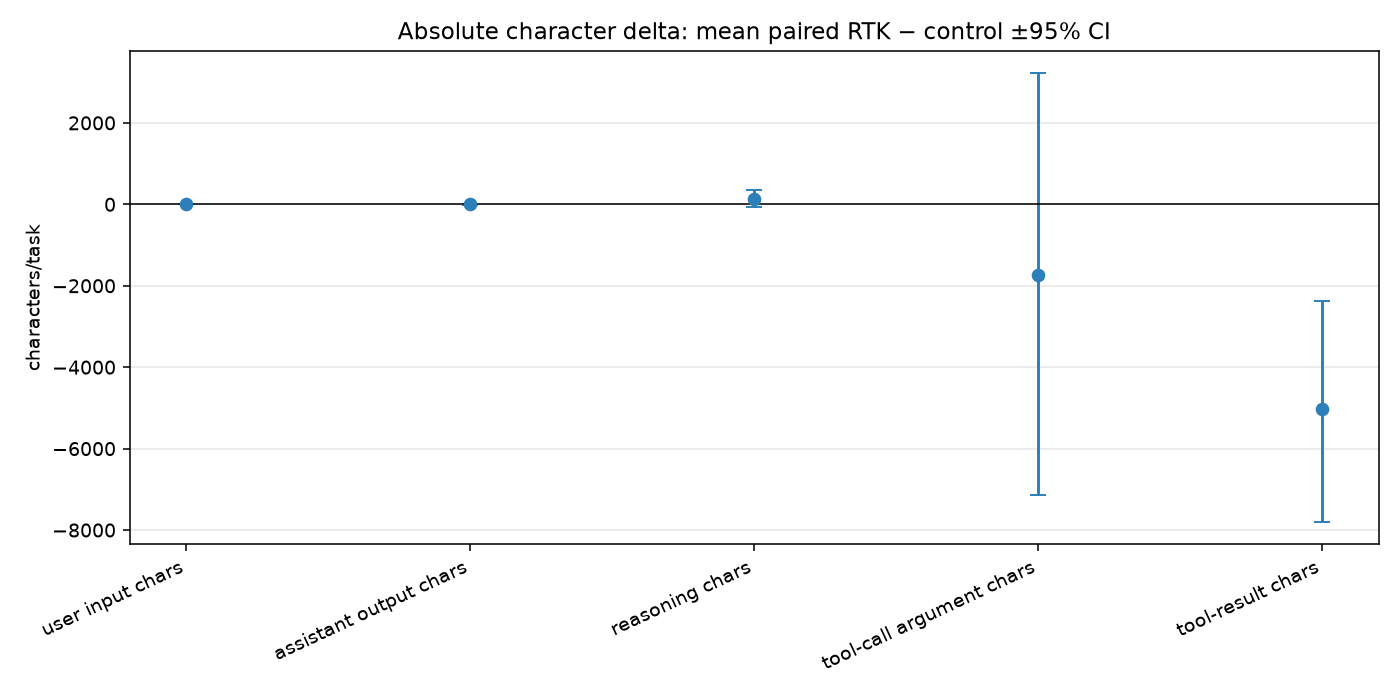
This is exactly the part of the interaction RTK is designed to change with user messages, assistant prose, and reasoning not materially changed.
But the average hides the most important part of the result: the savings are concentrated in the biggest tasks. We sorted tasks into six equal-sized bins based on the number of tool-result characters in the control run. B1 has the fewest; B6 has the most.
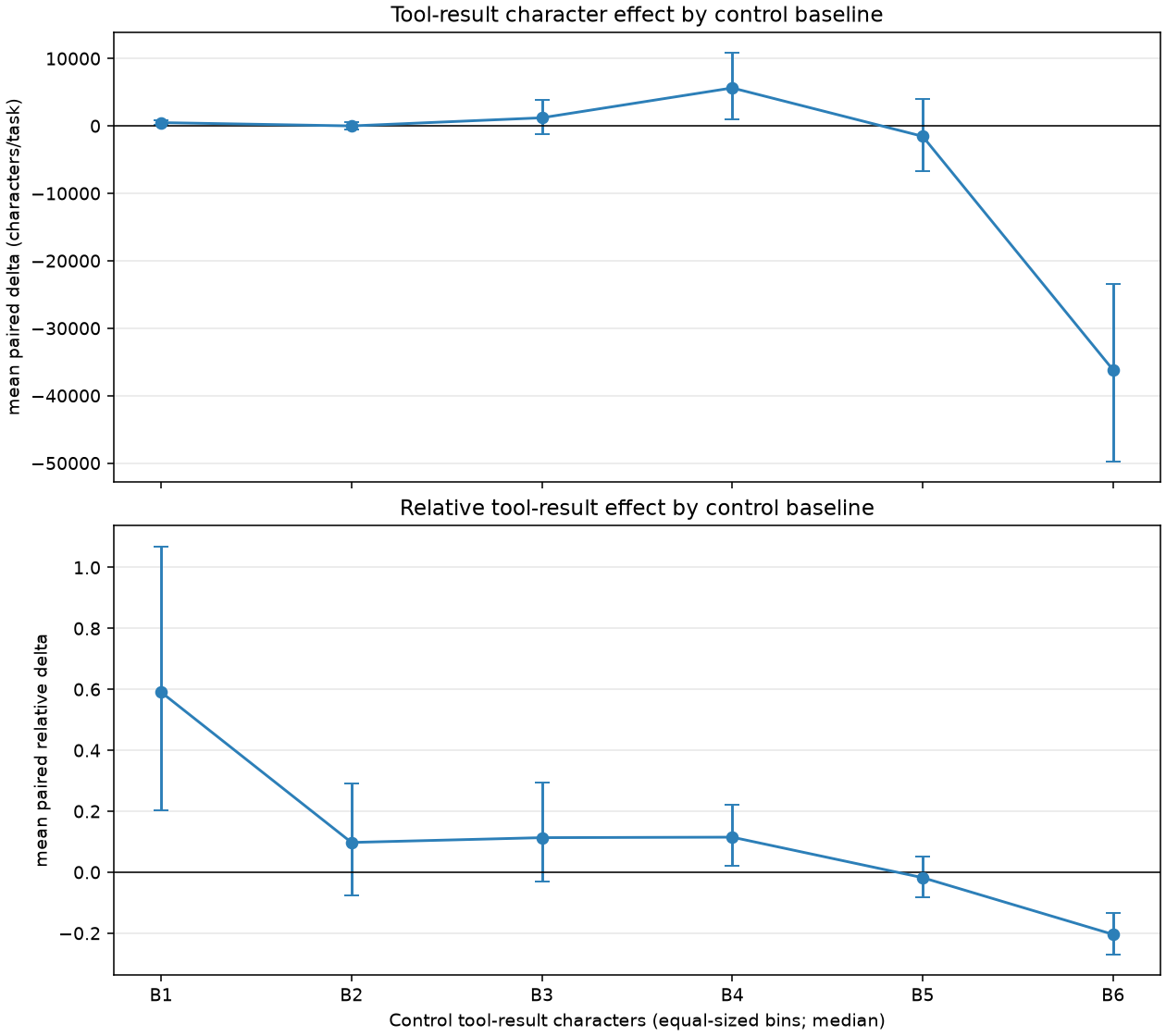
In B1 through B5, RTK and the control arm have roughly similar tool-result volume. In B6, the tasks with the largest and most complex tool results, RTK saves about 36,000 characters, or roughly 20%. That is around 9,000 tokens using the same approximation. Nearly all of the aggregate tool-output savings come from this final bin.
This is a useful practical rule: output compression matters most when an agent is already dealing with a large amount of terminal evidence. On a small task, there may not be enough repetitive output for RTK to matter. Looking at these tasks, it's clear that the largest outputs are ones where the AI bit off more than it could chew: huge file outputs where it only needed a little of the data.
More messages complicate the picture
RTK does not simply make every task shorter. On average, the RTK runs contain 0.8 more LLM messages per task, about 12% more than the paired control run. A message may contain a tool call, reasoning, or ordinary output; the increase is not concentrated in just one message type.
Again, the task-size breakdown is more informative than the average. We sorted tasks into six equal-sized bins based on the number of control messages.
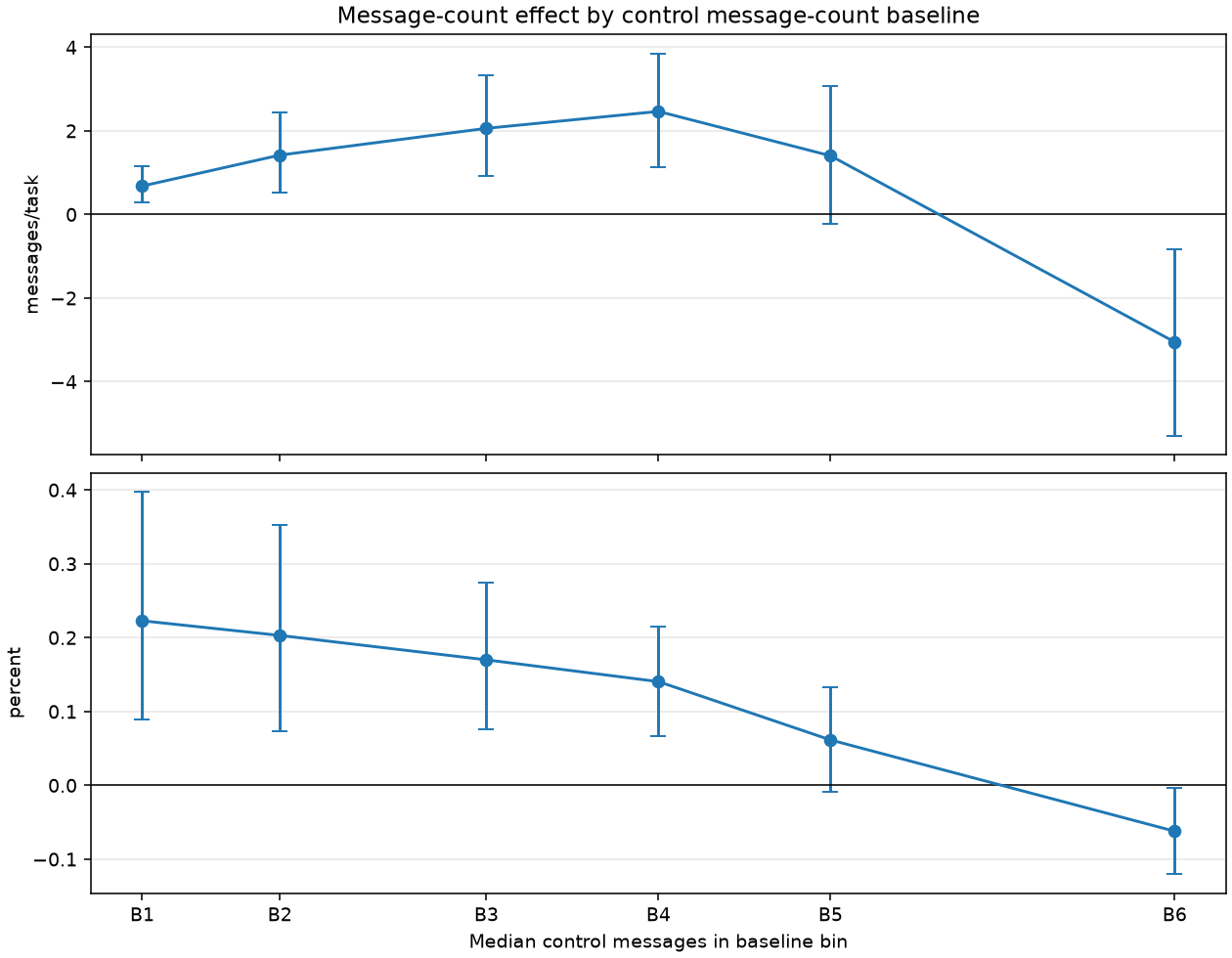
RTK adds messages in B1 through B5. The largest increase is in B4: about 2.5 extra messages, or 14%. But in B6, RTK produces 3.1 fewer messages, a 6.2% reduction.
The largest tasks are therefore different in both ways that matter: RTK removes a large amount of tool-result content and helps the model finish with fewer turns. Smaller and medium-sized tasks can pay a message-count penalty, which partly offsets the benefit of smaller individual results.
Why might a smaller tool result produce more messages? The model may receive less detail than it would have received from the raw command. The models are likely trained on traditional tool output, so the condensed RTK output may confused the model requiring subsequent queries.
The cost waterfall
We can combine these effects with a waterfall analysis. Start with the control cost, then change one factor at a time:
- the extra message volume increases cost by about 5%;
- the lower cost per message decreases cost by about 9%;
- the combined result is about 4% lower cost.
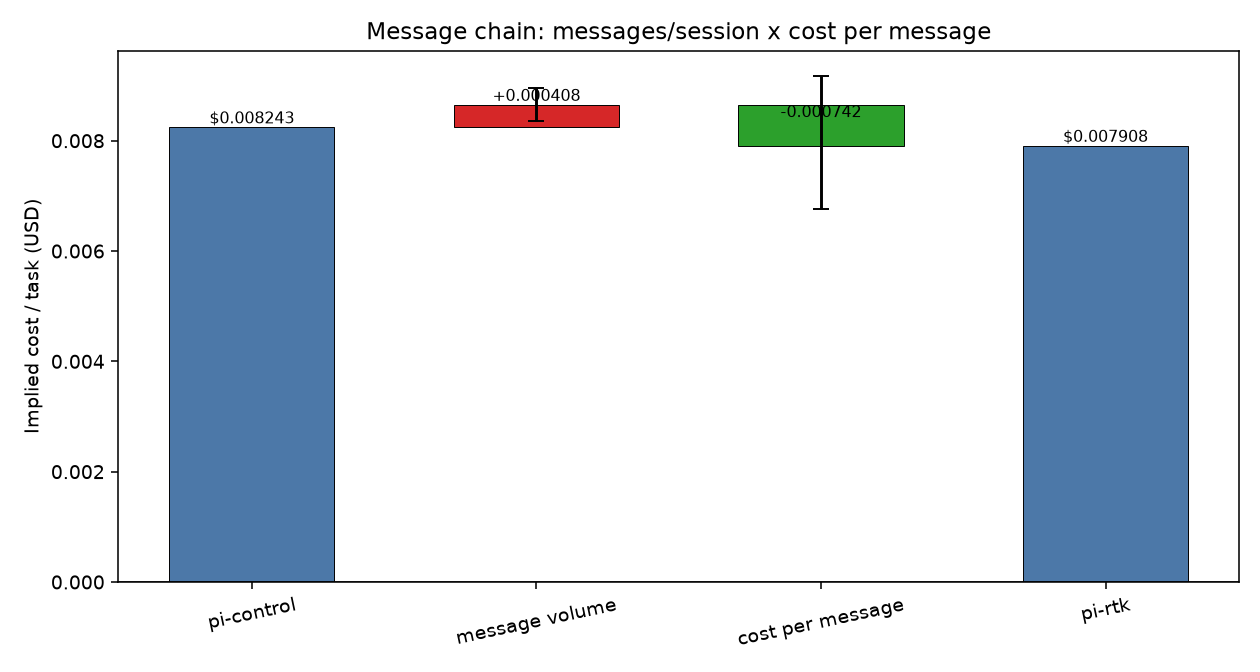
This is an accounting decomposition, not a claim that every task gets cheaper. The paired tasks vary substantially, and the average is influenced by the long tail. It tells us why the aggregate moves: RTK's messages are cheaper on average, and that effect is larger than the cost of the extra messages.
RTK only reaches only 2.8% of messages
There is another reason the end-to-end effect is modest: RTK does not process most of the messages in an agent session.
The RTK claims are usually stated as a reduction in the output of a command that RTK supports, a subset of bash output. A tool-using LLM session contains much more than those outputs: user instructions, assistant messages, reasoning, native tool results that don't use bash, and Bash output from commands that RTK does not transform.
When you boil that all down, RTK only affected 2.8% of all observed messages. Even among Bash outputs, RTK only affected about 9.7% messages.
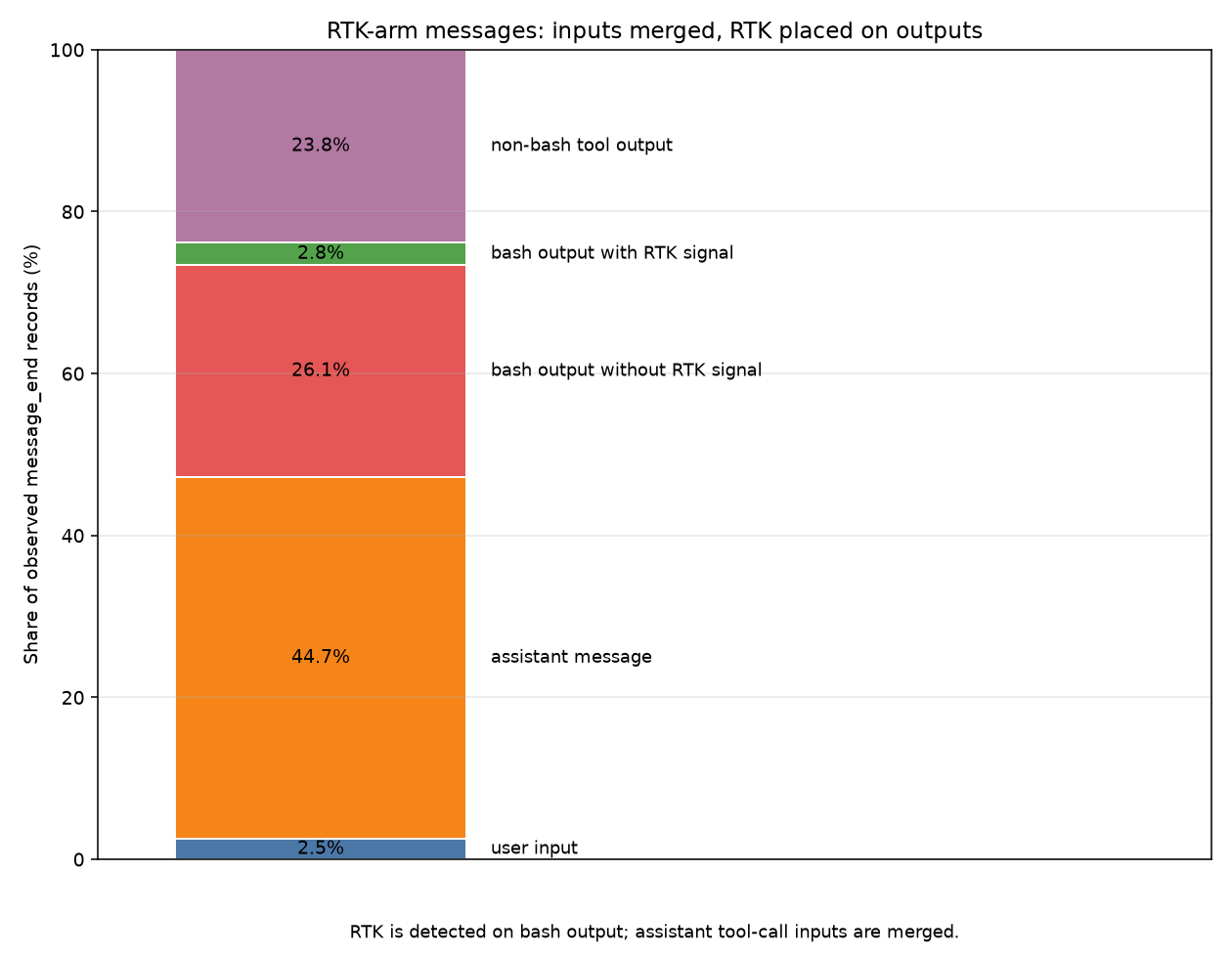
Note that the above are message counts, not token counts. In general, bash output tends to be a lengthier output so this may understate the impact of RTK. However, tool outputs are LLM inputs whose tokens are billed at less than LLM output tokens, making potential RTK savings smaller. A 60–90% reduction applied to 2.8% of observed messages cannot produce a 60–90% reduction in the whole LLM interaction. That limited reach helps explain why a large reduction in a particular tool result becomes a much smaller overall reduction in token cost. RTK is targeting a valuable part of the context, but it is targeting a minority of the messages.
Comparison with JetBrains' Claude Code benchmark
JetBrains recently published a similar result in a different setup on a smaller benchmark. Their paired SkillsBench evaluation used Claude Code 2.1.201 with Claude Sonnet 5: RTK increased median billed cost by 7.6% (compared to our 4% cost reduction) at low reasoning effort and had no measurable effect at high effort. Their task quality was unchanged.
Beyond the headline numbers, the studies broadly agree. The studies agree on the mechanism, even where their end-to-end results differ. RTK compresses only a small part of an agent transcript. JetBrains estimated that eligible output represented about 3% of input tokens; our message-count analysis found RTK affected 2.8% of all messages. Both studies also found that compressed output can lead to extra turns or rereads. JetBrains measured 13.8% more turns at low effort, while our smaller and medium-sized tasks incurred more messages, but our largest tasks used fewer.
While the results agree broadly, the small differences are likely due to the different models (Claude Sonnet 5 vs. GPT Luna), harness (Claude Code vs. Pi), and benchmark tasks (their 86 vs. our 600). The harness difference is subtle: Claude Code comes with a number of built-in tools (e.g., Grep, WebFetch) where vanilla Pi would use native bash commands (e.g., grep and fetch). This gives RTK more scope to improve performance in Pi than Claude Code. So while both analyses show that its impact is small, RTK may make sense for Pi but not for Claude Code.
Conclusion
RTK is not a general-purpose token discount applied uniformly to every agent run. Its benefit appears where it should: in large, noisy tool results. For the biggest tasks in this benchmark, it removes roughly a fifth of the tool-result characters and is associated with fewer messages as well. For smaller tasks, the model sometimes makes extra calls, perhaps to recover extra detail, reducing or reversing the benefit. And regardless of task size, RTK only targets a small percentage of messages in the LLM conversation.
In this 600-task comparison, the net effect was modest but positive: a statistically significant 4% lower token cost, well under the advertised headline 60–90% reduction.